What is a Massage Gun and What is it Used For
A massage gun is a motorized device that applies percussive massage, meaning a massage head repeatedly strikes the muscle at high speed with a short, controlled amplitude, simulating the effect of a deep manual massage in a more intense and localized way.
The effect occurs at two levels:
- At the tissue level, the repeated impact helps loosen the fascia, the layer of connective tissue that surrounds the muscles which, when tight, contributes to the feeling of a "stiff" or tense muscle.
- At the same time, there is a neurological effect: the rhythmic pressure activates sensory receptors in the muscle and tendon that send signals to the brain indicating that the tension is being worked on, and it is this signal that prompts the brain to command the muscle to relax, similar to what happens in a manual massage, only faster and more localized.

It is mainly used for three things: relieving muscle tension and trigger points, improving blood circulation in the treated area, and preparing or relaxing the muscle before and after physical exertion. This is why it has become a common tool both in a clinical context, used by physical therapists, and in the daily routine of those who train regularly.
Benefits of Percussive Massage
Percussive massage acts on muscle tissue more deeply than conventional manual massage, as high-frequency vibration helps release areas of tension that would otherwise take longer to loosen.
Among the benefits most associated with regular use are the reduction of delayed onset muscle soreness (DOMS), improved range of motion when used before exercise, and a decrease in the feeling of accumulated fatigue over the training week.
A meta-analysis published in the Journal of International Medical Research, which gathered 10 studies and 258 participants, found a significant reduction in muscle pain felt up to 72 hours after exercise in those who used vibration therapy, the same principle upon which percussive massage is based.
How to Use a Massage Gun for Muscle Recovery
The moment you use the gun changes what you should expect from it. Before training, the goal is to activate the muscle, not tire it: press lightly for 3 to 5 seconds per area, at low intensity, and move slowly up and down, just to prepare the body without leaving it overloaded before the effort. After training, the focus shifts to recovery itself: spend between 5 and 10 minutes on the whole body, with more attention to areas like glutes, hamstrings, forearms, and the area between the shoulder blades, where tension tends to accumulate faster. If there is a specific, more painful spot, such as the upper calf, work it in isolation for 10 to 30 seconds, breathing deeply while the initial discomfort passes.

Integrated this way, the massage gun does not replace the rest of the recovery routine, it adds to it: it fits well after training, before sleeping on days of greater accumulated tension, or even on rest days, when the goal is simply to keep the body ready for the next session without letting stiffness set in.
Which Massage Gun to Choose
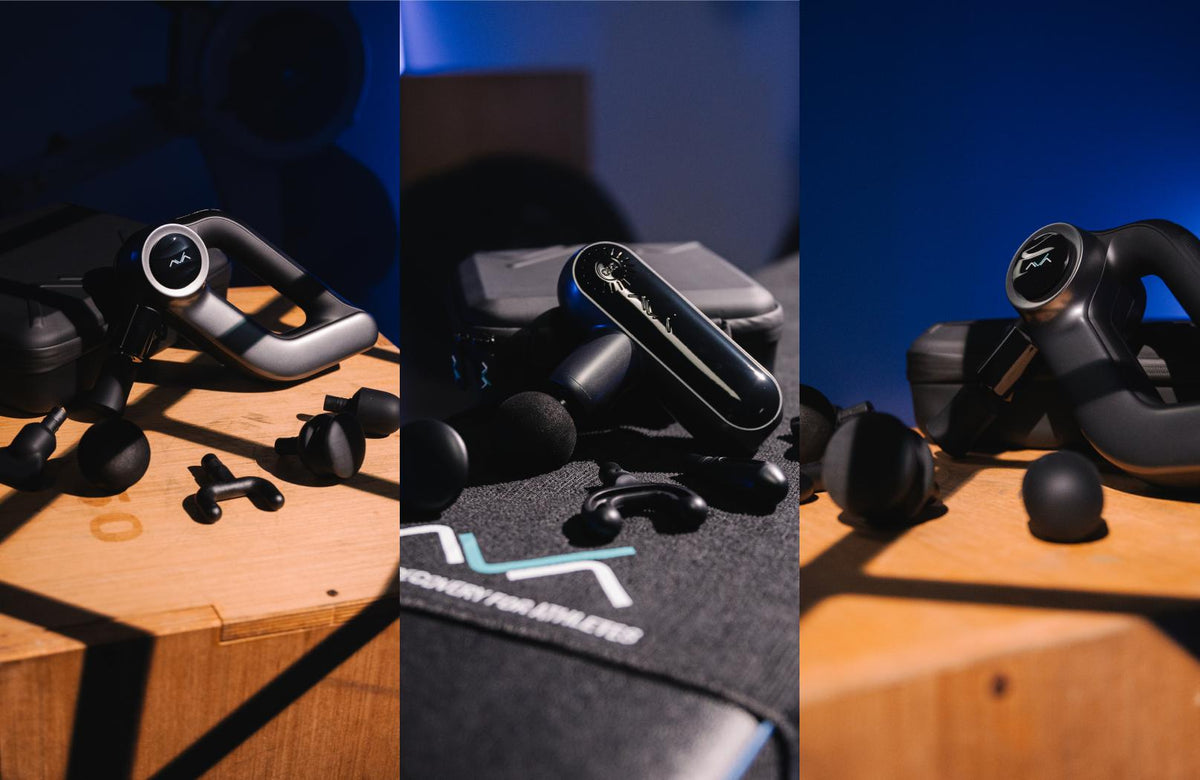
The AVACR7 range has four guns, organized almost like a ladder of requirements: it starts with an option designed for the daily life of those who train, moves up to a level already used by both competitive athletes and physical therapists, and ends with two top-tier models designed for those who work with muscle recovery every day, whether in a clinic or in high-level competition.
MiniGun, the most practical for the athlete's daily life
The MiniGun is the entry point of the range and is most designed for those who train regularly and want a solution that is easy to use alone. It weighs only 477g, has an ultra-torque motor with a speed between 1800 and 3000 rpm, 5 intensity levels, and comes with 5 interchangeable heads, as well as a battery with about 3 hours of autonomy.
It is compact enough to take to the gym, on a trip, or simply store in a drawer at home, making it the most practical choice for those who want quick relief without complicating their routine. Despite the entry-level format, it is already used by professional athletes in various sports (basketball, futsal, triathlon, padel) precisely because of its practicality.

Pro Physio, the bridge between the demanding athlete and the clinic
The Pro Physio clearly moves up a level: speed between 900 and 3200 rpm, 11 mm of penetration amplitude, 5 force levels, and a 4-stage pressure indicator that shows exactly how much force you are applying, something that none of the other three has. It works in silent mode (60 dB), which is already thought of for a clinical context, and has up to 5 hours of autonomy.
This is why AVACR7 presents it as "clinical performance in the palm of your hand": it serves both the high-performance athlete who wants more control over the intensity of the session, and the physical therapist who needs a silent and precise work tool to use with multiple patients throughout the day.

Pro Physio Pro and Pro Physio Pro Max, the top of the range
The Pro Physio Pro and the Pro Physio Pro Max share the same 12 mm amplitude, frequency up to 60 Hz, 6 heads, and a smart 10-minute session timer, designed for those who use the gun intensively and benefit from an automatic limit per session. They are the two options with the most power in the range, and this is where the site's indication begins to include physical therapists and competitive athletes.
The real difference between the two is in the arm: the Pro Physio Pro Max has a rotating arm with 5 adjustable angles, which makes it easier to reach areas like the back or shoulders alone without needing help from another person, while the Pro Physio Pro maintains a fixed design, more suitable for those who value stability in the grip or will use it mainly in a clinical context, where the physical therapist controls the application angle.

Guns with Heat, When Vibration Isn't Enough
There are days when the muscle is so stiff that vibration alone takes a while to take effect. For those cases, the MiniGun and the Pro Physio Pro and Pro Max have compatible heating heads, which add therapeutic heat, adjustable between 42°C and 50°C, to the percussion, to relax the muscles before the massage acts in depth. It is a combination that usually helps a lot on days of greater stiffness or before more intense training sessions, and we will dedicate a separate article to it soon, with all the details on how and when to use each temperature.
Technique and Danger Zones: How to Use the Gun Safely
Always select the head according to the muscle group you are going to work on: the rounder and wider ones are for larger areas like thighs or back, while the smaller and pointier ones are for specific tension points.
Turn on the device, choose a low to moderate intensity level to start, and run the head slowly over the muscle, without pressing hard, letting the motor do the work. In most cases, the lowest level is sufficient, and it is better to spend more time on one area than to increase the intensity looking for faster relief.
There are areas where the gun should never be used: the throat and neck area where large blood vessels pass, the inner forearm, the groin, and any bone or joint, including the spine. Also avoid applying directly over wounds or areas with active injury, and if you feel sharp pain instead of relief, stop and seek evaluation from a health professional before continuing to use the equipment in that area.
